Which FinOps Platform Fits on AWS — and Who Implements It
Quick summary: CloudZero, Vantage, Finout, nOps, ProsperOps, and Kubecost on AWS — platform selection guide plus who implements tagging, allocation, and architecture savings.
Key Takeaways
- CloudZero, Vantage, Finout, nOps, ProsperOps, and Kubecost on AWS — platform selection guide plus who implements tagging, allocation, and architecture savings
- This hub helps AWS teams select the right tool and close the implementation gap when dashboards outpace architecture changes
- Implementation pairing: Tagging strategy, Cost Categories, CUR 2.0 pipeline, cost pitfalls remediation
- Implementation pairing: Tag policies (Organizations), split cost allocation for EKS, Bedrock cost attribution
- nOps — AWS-native cost optimization Does well: AWS-focused recommendations, EKS optimization, commitment management, ShareSave
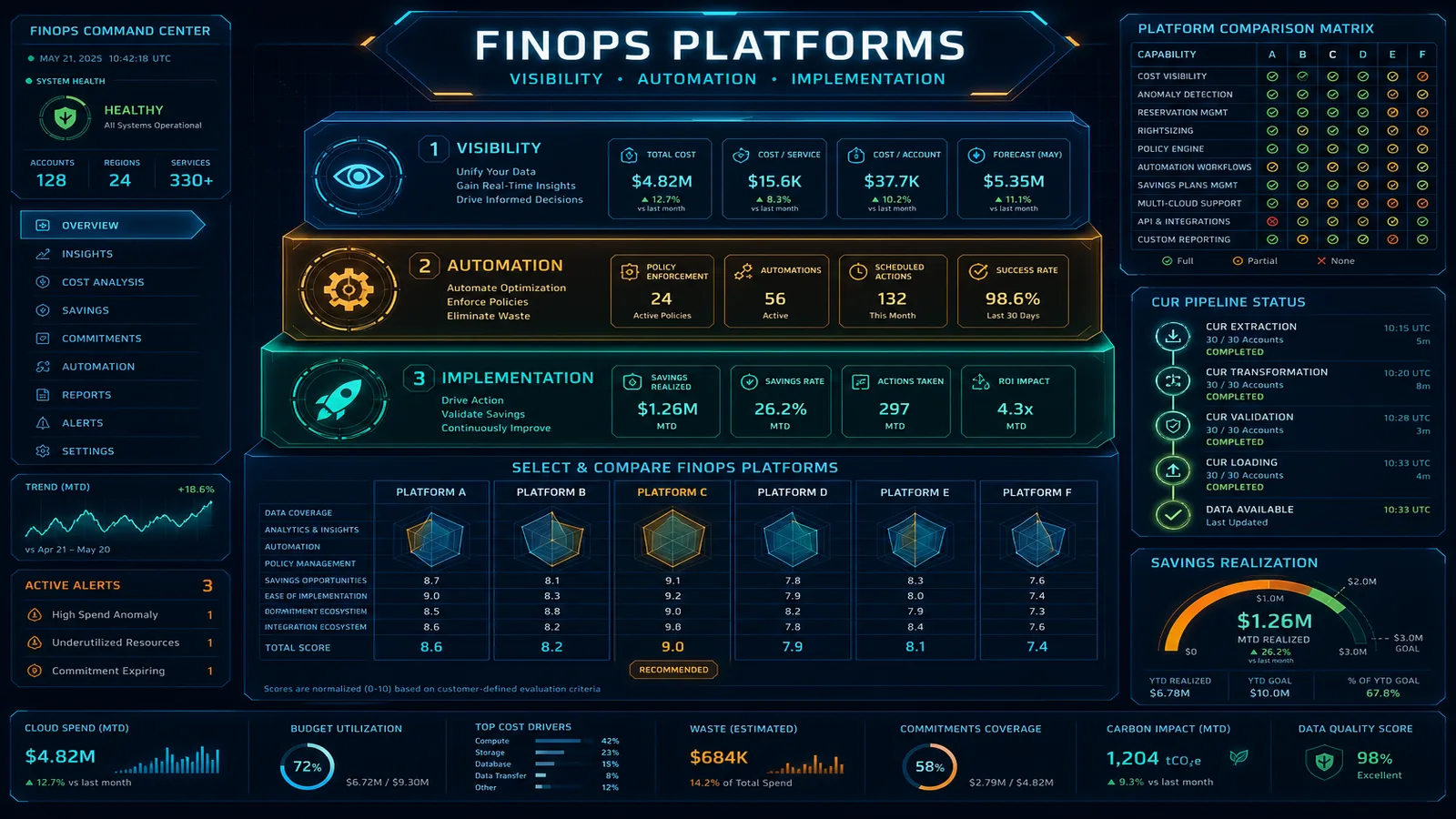
Table of Contents
As of June 2026, AWS Cost Optimization Hub consolidates waste and rightsizing recommendations across EC2, Lambda, EBS, RDS, and other services directly in-console — before you buy a third-party FinOps subscription, confirm your CUR 2.0 export and tag policies are trustworthy.
A typical engagement shape we see: a B2B SaaS on AWS, 8–15 linked accounts, $60k–$150k/mo spend, FinOps platform subscribed for 6+ months, allocation gaps visible in dashboards but engineering backlog unchanged. The missing layer is not another tool — it is architecture execution.
FinOps platforms excel at cost visibility, allocation, and commitment automation. They do not delete NAT Gateways, fix cross-AZ topology, or deploy the tagging strategy that makes unit economics trustworthy.
This hub helps AWS teams select the right tool and close the implementation gap when dashboards outpace architecture changes.
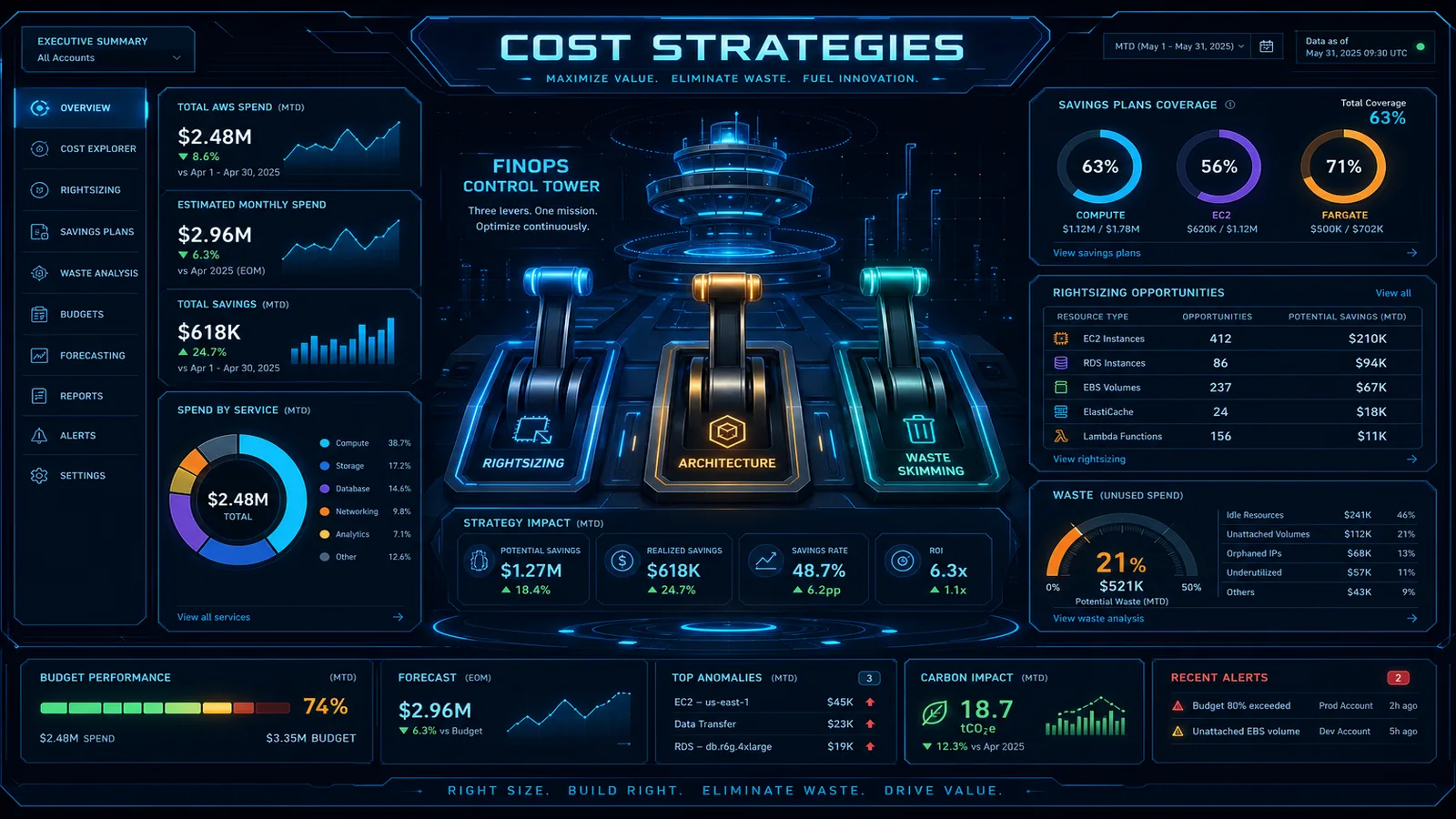
The Three-Layer FinOps Stack
| Layer | Examples | What it delivers |
|---|---|---|
| Visibility | Vantage, CloudZero, AWS Cost Explorer + CUR | Where spend goes |
| Automation | nOps, ProsperOps, Zesty, Spot Eco | RI/SP purchases, recommendations |
| Implementation | FactualMinds | Architecture fixes, tagging ops model, realized savings |
Core message: Dashboards don’t delete NAT Gateways. We implement the architecture changes your FinOps platform recommends.
Platform Selection Guide
Vantage — multi-cloud cost management
Does well: Fast setup, free tier, provider integrations, team dashboards.
Stall point: Teams outgrow visibility without allocation discipline or architecture changes.
Implementation pairing: Tagging strategy, Cost Categories, CUR 2.0 pipeline, cost pitfalls remediation.
CloudZero — cost intelligence for engineering
Does well: Unit economics, Kubernetes cost dimensions, engineering-friendly views.
Stall point: Dimensions require accurate tags and consistent service attribution — garbage in, garbage out.
Implementation pairing: Tag policies (Organizations), split cost allocation for EKS, Bedrock cost attribution.
Finout — allocation and FinOps analytics
Does well: Multi-cloud allocation, custom business metrics, FinOps Foundation alignment.
Stall point: Custom metrics need CUR enrichment and stable resource naming.
Implementation pairing: CUR Athena/Glue pipeline, allocation rules workshop, showback model.
nOps — AWS-native cost optimization
Does well: AWS-focused recommendations, EKS optimization, commitment management, ShareSave.
Stall point: Recommendations queue without engineering capacity to execute architecture changes.
Implementation pairing: nOps vs AWS native FinOps comparison, rightsizing execution, VPC endpoint rollout.
ProsperOps — Savings Plans automation
Does well: Automated SP portfolio management, risk-adjusted commitment strategy.
Stall point: Autopilot without baseline modeling can over- or under-commit.
Implementation pairing: ProsperOps implementation guide — baseline workshop before automation.
Kubecost — Kubernetes cost optimization
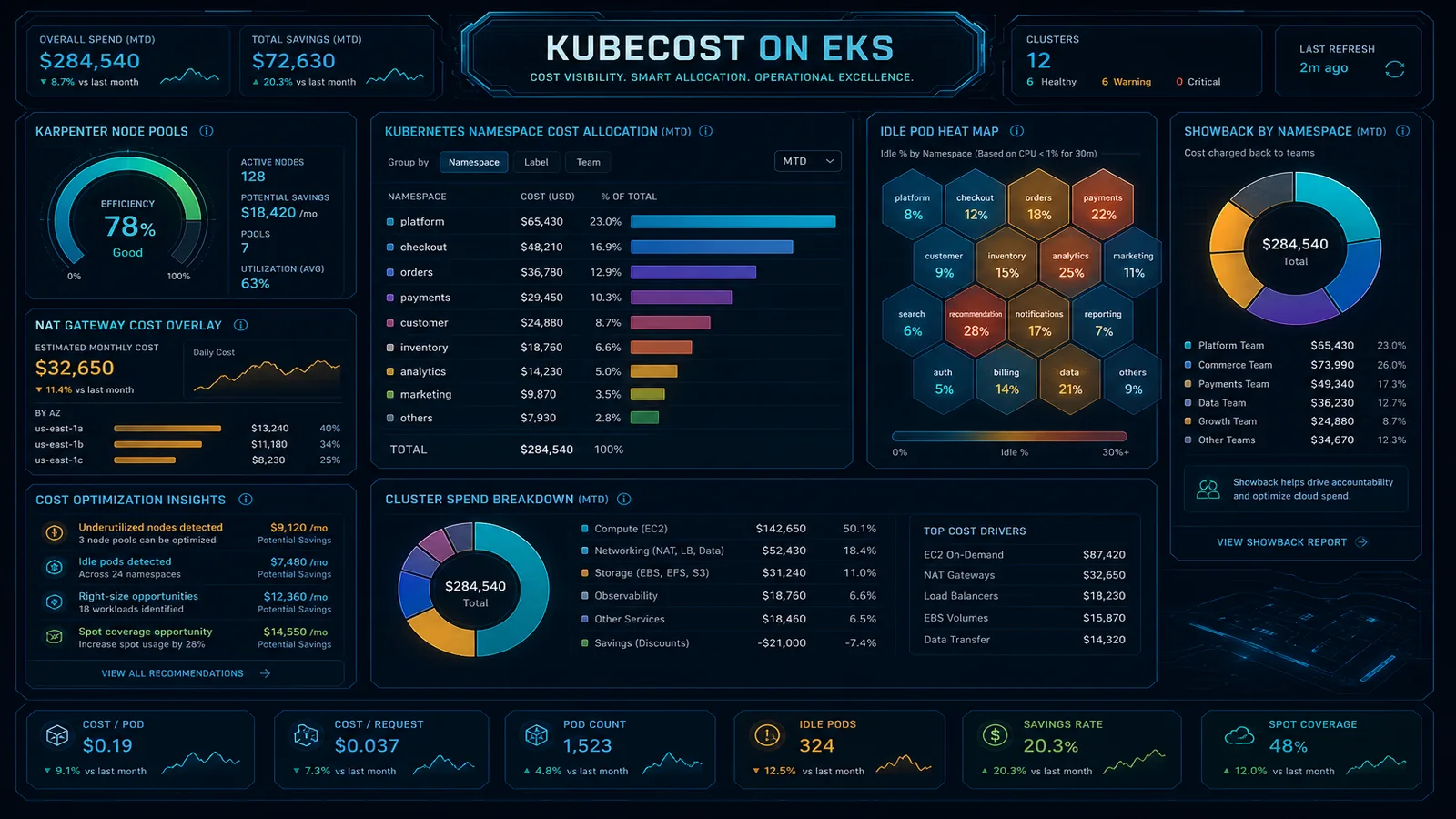
Does well: Pod/namespace cost allocation, showback/chargeback for EKS.
Stall point: Attribution visible but cluster still over-provisioned; no Karpenter/topology fixes.
Implementation pairing: Kubecost + EKS optimization.
CloudBurn — open-source cost policy engine
Does well: IaC policy checks and live AWS scanning for cost guardrails.
Stall point: Policies find violations; remediation still needs IaC changes.
Implementation pairing: Policy-as-code in CI/CD + architecture sprint for recurring violations.
When You Need Implementation Help (Not Another Tool)
| Signal | Action |
|---|---|
| Cost Explorer flat despite FinOps SaaS subscription | Architecture audit — NAT, cross-AZ, logging, idle resources |
| Allocation accuracy below 80% | Tagging operating model + Cost Categories |
| SP/RI coverage wrong after growth or architecture change | Commitment strategy workshop before re-enabling autopilot |
| FinOps dashboard unused by engineering | FinOps Foundation Build — rituals, dashboards, accountability |
| EKS cost up, Kubecost shows “efficient” namespaces | Cluster rightsizing, Karpenter, topology-aware routing |
FactualMinds FinOps Foundation Build (4–8 weeks)
Fixed-scope deliverables:
- CUR 2.0 pipeline and Cost Categories
- Tag policies and allocation accuracy target (typically 85%+)
- Quarterly optimization cadence wired to cost pitfalls playbook
- Top 5 architecture fixes with measured savings
- Handoff to your FinOps platform (Vantage, CloudZero, nOps, etc.)
We configure your platform — we don’t replace it.
What to Do This Week
- Audit your CUR pipeline — confirm CUR 2.0 export to S3 and Athena/Glue connectivity before evaluating SaaS.
- Pick one platform category — visibility, automation, or Kubernetes allocation; don’t buy three tools solving the same layer.
- Schedule a baseline review — if allocation is below 80%, fix tags before enabling autopilot on ProsperOps or nOps ShareSave.
What This Post Doesn’t Cover
Vendor pricing negotiations, multi-cloud FinOps for Azure/GCP-heavy estates, and Bedrock token economics — see our FinOps tools vs consulting comparison for the platform-vs-execution frame.
Related Reading
- FinOps tools vs AWS cost consulting
- AWS Cost Optimization & FinOps services
- For FinOps teams
- FinOps governance playbook (GitHub)
- Free AWS Cost & Architecture Audit